



RAID 5 Data Recovery, RAID 50 Data Recovery Service
RAID 5 arrays are primarily used for data warehousing solutions where the number of read requests significantly outweighs the write requests. 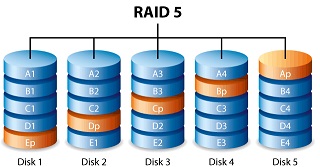 RAID 5 uses data striping to provide fault-tolerant data storage and does not duplicate data as RAID 1 or RAID 10 does. Data is striped across all drives in the array. For each stripe (one stripe unit from each disk) across the array, a stripe unit is reserved to hold parity data calculated from the other stripe units in the same stripe. This yields improved read performance. However, there is a performance penalty for write operations because the parity data must be recalculated and written to the parity stripe unit along with the new data.
The RAID 5 controller itself can fail for various reasons, preventing the array from being rebuilt and recovered. As a result, you are left with multiple disks, all containing your data, but you cannot access it. This is when you need genuine RAID 5 data recovery services. The engineers at FixmyData are experts at recovering RAID 5 arrays regardless of the cause of failure, including collapsed arrays where two or more drives have failed simultaneously. Multiple drive failures in a RAID 5 failure require the right equipment and experience to preserve the highest chance of a successful recovery.
What Are the Causes of RAID 5 Failure?
- Multiple hard drive failures
- RAID controller failure
- Overheating
- Volume deletion or reformatting
- Incorrect disk replacement
- Interrupted rebuild process
RAID 5 has long been the standard in server environments requiring fault tolerance. RAID parity requires one disk drive per RAID set, so the available capacity is always one less than the number of disks in the available disk configuration. This is still better than RAID 1, which has only 50% usable capacity. A RAID 5 array requires a minimum of 3 disks and can be implemented with up to 16 disks, with usable capacity ranging from 67% to 94% depending on the number of data drives in the RAID array.
 RAID 50, also known as RAID 5+0, combines distributed parity (RAID 5) with striping (RAID 0) and requires at least 6 drives. It combines two RAID 5 configurations into a RAID 0 configuration. However, not every controller supports RAID 50. RAID 50 provides an excellent balance between storage capacity, array performance, and data integrity, which other RAID levels do not offer. Performance does not degrade as severely as in a RAID 5 array because a single failure affects only one array. Up to 2 disk failures can be overcome as long as they affect different RAID 5 arrays. As you increase the number of drives in RAID 5, you also increase the likelihood of failure because multiple drives can fail simultaneously.
Compared to a RAID 5 configuration, RAID 50 uses additional disk space for parity to reduce the risk of system crashes.
RAID manufacturers differ greatly in the design of internal components and circuitry in their hardware. In-depth understanding of these designs is crucial for successful data recovery. However, as manufacturers do not disclose this information, RAID recovery techniques require years of development and reverse engineering to determine which are most effective.
Our RAID Data Recovery Process Meets Manufacturer Specifications.
We Can Recover Data from Hard Drive RAID Arrays Produced by the Following (but not limited to) Manufacturers:
Latest Publications
Ransomware data rescue: in-depth analysis and professional recovery strategies
Read more..
Data recovery technology frontier: a comprehensive solution from physical failure to logical repair
Read more..
Server RAID data recovery: the last line of defense guarding enterprise core data
Read more..