

Hard disk physical sector architecture and data reading process
Ready to get started?
You can mail us your storage media or visit our company address.
Hard disk physical sector architecture and data reading process
What does it mean if the disk drive suddenly stops responding or the hard drive crashes directly?
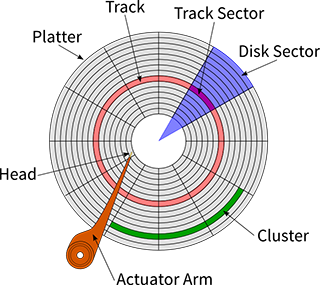 When data is written to a drive, it is encoded. The actual data itself is never written directly; only the interpretation of the data is written. If you think that what is stored in the drive is 0s and 1s, you are mistaken. Data is more like a waveform that is written to the drive. When reading, it must first be interpreted before it becomes 0 or 1. Data is randomized before being written. This eliminates possible identical patterns to avoid ECC (Error Correction Code) confusion. Pattern detection for recurring patterns is difficult.
If you are using any diagnostic software, it is crucial to understand the data structure of the written sectors. Many software programs use generic terminology to discuss error types
When data is written to a drive, it is encoded. The actual data itself is never written directly; only the interpretation of the data is written. If you think that what is stored in the drive is 0s and 1s, you are mistaken. Data is more like a waveform that is written to the drive. When reading, it must first be interpreted before it becomes 0 or 1. Data is randomized before being written. This eliminates possible identical patterns to avoid ECC (Error Correction Code) confusion. Pattern detection for recurring patterns is difficult.
If you are using any diagnostic software, it is crucial to understand the data structure of the written sectors. Many software programs use generic terminology to discuss error typesCommon hard disk error codes and diagnostics:
BSY - Drive busy
DRDY - Drive ready, can accept commands
ERR - The previous operation resulted in an error
DREQ - Exchange data with the host
UNCR - Uncorrectable Error
WRFT - Write Fault
IDNF - Sector ID Not Found. If the sector storing this information is damaged, the hard drive will be unable to locate the sector and return an IDNF result.
AMNF - Address Mark Not Found. This is similar to IDNF, but pertains to data. If an error occurs and this mark is corrupted, the data in that sector cannot be located. The data in this area is 512 bytes of user data.
ABRT - Abort. This is an abort error, and the drive will stop attempting to read the data block.
TONF - Track 0 not found
An ECC error indicates a problem and mismatch during the reading of ECC. ECC is used to check the integrity of the read data. When reading data, the drive calculates the ECC and performs a comparison. If an error occurs, the drive will retry until it cannot obtain the correct result, and then return an UNCR error.
UNCR - Uncorrectable Error
WRFT - Write Fault
The magnetic head uses servo information to identify the correct track. Then, the magnetic head reads the ID block of each sector through a "converter" to determine whether it is the target sector. If the ID field is damaged, the target for data retrieval cannot be identified, and an IDNF error will be marked. If the correct sector ID is found, the magnetic head will then read the address mark corresponding to the 512-byte data at that location. If this information is corrupted, the magnetic head cannot locate the starting position of the data and will return an AMNF error. An AMNF error indicates that the ID tag information has been found, but the data in the address tag corresponding to that address has not been found, resulting in the loss of 512 bytes of user data.
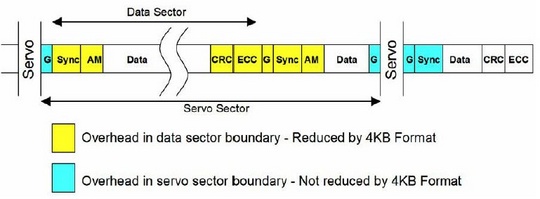
After data is written, a 4-byte ECC data block is also written. After reading 512 bytes of data, the drive calculates the ECC information and reads the ECC data block for comparison. If they are not equal, the drive will re-read the data until it times out, resulting in an ECC data error. If the error cannot be corrected through re-reading, the UNC flag bit will be set to indicate that the error data is uncorrectable. You can try to ignore the ECC and perform data recovery, but you will not be able to verify whether the read data is correct. This should be used as a last resort to capture data that cannot be read through other means. The magnetic head uses servo information to identify the correct track. Then, the magnetic head reads the ID block of each sector through a "converter" to determine whether it is the target sector. If the ID field is damaged, the target for data retrieval cannot be identified, and an IDNF error will be marked.
The drive will attempt several different methods to re-read data before giving up, with most of them utilizing ECC. In certain specific scenarios, if data appears in a particular order, ECC may incorrectly correct the data. ECC read commands use odd numbers with a minimum of 3, to avoid a 50/50 probability when choosing 2. Ignoring ECC read is the LBA 28 command "Read Long", which has been disabled in 48-bit addressing because it is considered outdated in drives exceeding 137GB. Drives above 137GB cannot use ignore ECC read. A standard attempt is usually made, typically 10 times in most hard disk drives. Ignoring ECC read on a drive may result in potential data corruption, but sometimes if there is a problem with the PCB (printed circuit board) or ECC cannot read data correctly, this is the only way to obtain data from these sectors.